
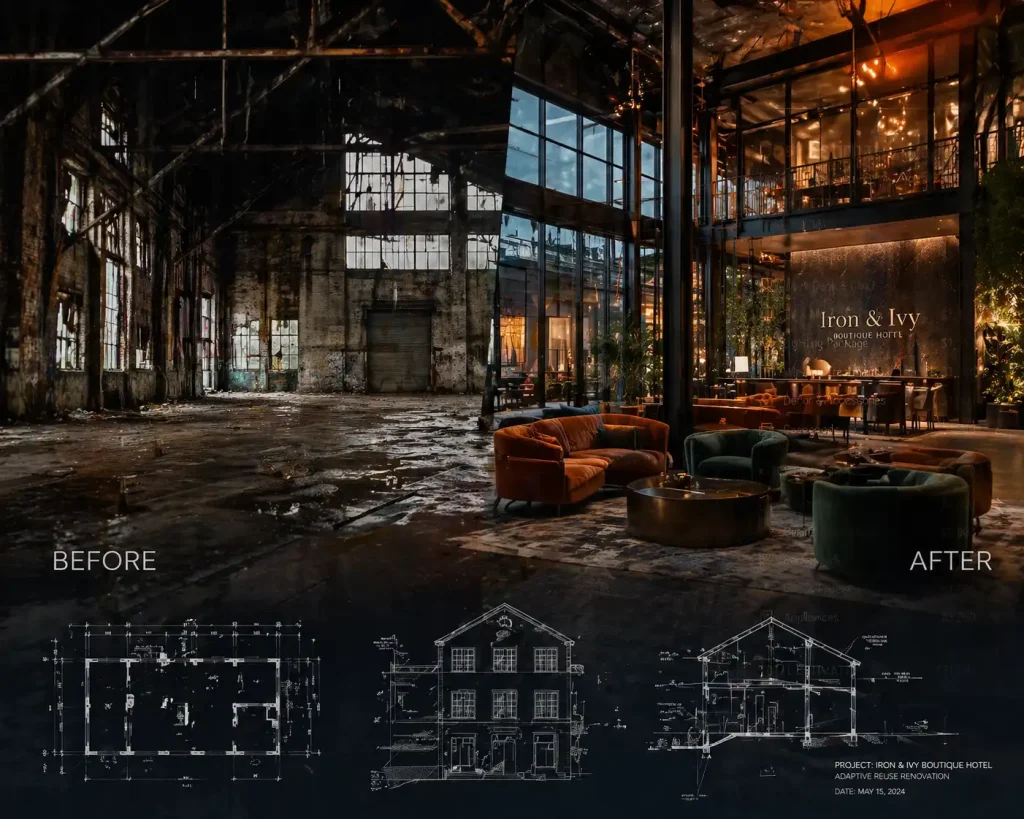
Adaptive reuse hotel projects have moved from architectural curiosity to mainstream investment thesis. Developers who once dismissed warehouse and historic school conversions as too expensive now see them as one of the few paths to differentiated boutique product in saturated markets. The economics have shifted, the permitting paths have matured, and consumer demand for properties with story is undeniable. The question is no longer whether these projects work. It is which buildings work, at what cost, and whether the specific site can absorb the surprises that always come with breathing new life into old structures.
Why Adaptive Reuse Has Exploded in 2026
Several market forces have aligned to make warehouse and school conversions financially viable in markets where they would have failed five years ago. Boutique hotels have outperformed branded properties on revenue per available room growth across most major markets, with travelers actively choosing properties that feel distinct over uniform branded experiences. New construction costs have risen faster than conversion costs in dense urban areas, narrowing the financial gap and in some cases inverting it. Federal historic tax credits, opportunity zone benefits, and state-level rehabilitation incentives produce capital stack advantages that ground-up construction cannot match. Environmental, social, and governance capital prefers existing-building reuse over greenfield development, which expands the pool of available financing.
The cumulative effect has been a meaningful increase in adaptive reuse hotel pipeline across the United States. Markets like Hartford, Worcester, Buffalo, and Newark have all seen warehouse and school conversion projects move from speculation to active development. The pattern that emerged from earlier office building to hotel conversions is now repeating with industrial and educational buildings, with operational lessons from those earlier projects shaping how developers approach the new category.
Warehouse Conversions: The Pros and Cons
Why Warehouses Convert Well
Warehouses offer specific advantages that align well with hospitality programming. Open floor plates allow flexible layouts that newer buildings simply cannot replicate without major structural reconfiguration. Ceiling heights typically run twelve to twenty feet, creating dramatic public spaces that became the foundation of boutique hotel aesthetics over the past decade. The industrial vocabulary, including exposed brick, steel columns, timber beams, and raw concrete, aligns directly with current design trends without expensive simulation. Many warehouses sit in emerging urban districts where land costs and demand fundamentals favor hospitality investment, particularly former industrial neighborhoods experiencing creative-economy growth.
Structural overdesign is the practical advantage developers often overlook. Industrial buildings were engineered for floor loads and column spacing that exceed what hospitality use requires, which means major structural reinforcement is rarely needed. The exterior masonry walls, when sound, provide the kind of weather and acoustic envelope that conventional construction takes years to develop.
Where Warehouses Get Expensive
The cost story changes when bringing services up to hospitality standard. Electrical service designed for industrial use rarely accommodates the load profile of a hotel with HVAC across every guest room, kitchen equipment, lobby technology, and amenity spaces. Plumbing infrastructure was designed for industrial drains and minimal restroom counts, which means new stacks, new supply lines, and meaningful slab penetrations are typically required. HVAC systems must be added wholesale because warehouses often relied on simple unit heaters or no climate control at all.
Window penetration on solid masonry walls drives unexpected cost. Boutique hotel guest rooms require natural light, but warehouse exterior walls were designed to be solid. Cutting new openings, installing structural lintels, and weatherproofing the new penetrations runs five thousand to fifteen thousand dollars per window in heavy masonry construction. Insulation and acoustic separation between guest rooms also runs higher than conventional construction because the original building lacks any internal partitioning. ADA compliance retrofits often surface during permitting, with elevator additions, ramp construction, and pathway modifications adding seven percent to fifteen percent of total project cost depending on the building.
Historic School Conversions: The Pros and Cons
Why Schools Convert Well
Historic schools offer a different set of advantages that complement what warehouses lack. Schools were already designed for human occupancy, which means life safety systems, code occupancy classifications, and accessibility considerations were already factored into the original construction. Existing classroom modules size remarkably well as guest rooms, typically running between four hundred and seven hundred square feet, which aligns with boutique room expectations. Public spaces like the auditorium, library, and gymnasium become unique amenity spaces that no purpose-built hotel can replicate, including event spaces, restaurants, lounges, and fitness centers with character that drives press coverage and guest interest.
Federal historic tax credits typically apply when the building is on the National Register of Historic Places or qualifies as a contributing property in a historic district. The credit equals twenty percent of qualifying rehabilitation expenses, which can produce capital stack advantages worth millions on larger projects. Local and state preservation programs often layer additional credits, and the embedded community story sells the boutique narrative without requiring fabricated marketing. The framework for choosing the right path between restoring, rehabilitating, or renovating a historic property applies directly to school conversion decisions and shapes whether tax credit eligibility is preserved.
Where Schools Get Expensive
Heavy preservation requirements turn the asset advantage into a cost burden. Schools on the National Register or in protected districts must preserve specific character-defining features, which often include original windows, masonry detailing, interior trim, and roof profiles. Window restoration costs, which are typically non-negotiable for historic, run between twelve hundred and four thousand dollars per window depending on size and complexity. Asbestos and lead paint abatement, common in buildings constructed before 1980, runs eighty thousand to four hundred thousand dollars depending on building size and material types present.
Plumbing reconfiguration for per-room bathrooms adds significant scope because schools were never designed for the bathroom density that hospitality requires. Mechanical retrofits for hospitality climate control require entirely new HVAC distribution since existing radiator-based heating systems cannot meet the comfort standards modern guests expect. Roof, masonry, and structural work also tends to surface during diligence, with deferred maintenance from years of declining occupancy producing repair scopes that can equal twelve percent of total project budget on older buildings.
Cost Comparison: Warehouse vs Historic School vs New Build
Comparing per-key costs across building types provides a useful starting point, with the understanding that property condition, location, and preservation requirements all swing these ranges meaningfully. New construction boutique hotels typically run between two hundred fifty thousand and four hundred fifty thousand dollars per key in major Northeast markets. Warehouse conversions run between one hundred eighty thousand and three hundred eighty thousand dollars per key, with the lower end achievable when structural condition is strong and the higher end reflecting heavy mechanical and envelope work. Historic school conversions run between two hundred twenty thousand and four hundred twenty thousand dollars per key, with the floor reflecting buildings in good condition and the ceiling reflecting full preservation overlays with comprehensive abatement.
These ranges include hard construction costs, FF&E, and standard soft costs but exclude land acquisition. The detailed framework for estimating commercial construction costs per square foot provides additional context for how regional cost factors and building condition adjust per-key economics. Tax credit capture, when applicable, can reduce effective per-key cost by thirty to seventy thousand dollars on qualifying historic projects, which often tips the financial model from unworkable to attractive.
The Feasibility Filter Most Investors Skip
The diligence checklist that separates successful adaptive reuse from costly mistakes runs through specific structural and regulatory questions before any pricing conversation begins. Floor plate efficiency determines whether the building can hit minimum room counts, since some warehouse and school footprints simply cannot accommodate enough keys to support the project pro forma after factoring in corridors, MEP rooms, and back of house space.
Vertical circulation review identifies whether existing stairs and elevator placement work for hospitality circulation patterns. Schools often have multiple stair towers placed for fire egress that work well, while warehouses sometimes lack any vertical circulation that meets current code. Plumbing stack feasibility determines whether new bathrooms can be located efficiently or whether stacks must be added throughout the building, which dramatically increases cost. Code occupancy classification path, the process of changing the building’s permitted use through local code authorities, can take six to fourteen months and may trigger major fire-rated construction upgrades. Historic preservation overlay restrictions limit what can be changed on the exterior and sometimes the interior. Parking requirements and zoning relief paths affect whether the project can satisfy local requirements without expensive variance processes. Structural capacity for new loads, including rooftop mechanical equipment, pools, or amenity decks, may require reinforcement that was not budgeted.
Permitting and Approval Timelines
Realistic timelines from acquisition to permit issuance run longer for adaptive reuse than for ground-up construction, despite the perception that working with an existing building should be faster. Warehouse conversions typically require eight to fourteen months to permit, with the variability driven by zoning relief needs, environmental review, and code occupancy classification. Historic school conversions typically require fourteen to twenty-four months to permit, with preservation review boards adding three to six months on top of standard permitting timelines.
Variances and zoning relief processes often move slower than developers anticipate. Hearing schedules, neighborhood notification requirements, and appeal periods can each add weeks. Preservation review boards, where historic buildings are involved, operate on monthly meeting cycles with submission cutoffs that can delay projects by additional weeks. Working with the local approval process from the day of acquisition, rather than from the day of design completion, compresses the calendar meaningfully. The strategic roadmap for the commercial construction process walks through how owners sequence these workstreams to keep momentum during what can otherwise become a stalled project phase.
Hidden Cost Categories Most Investors Underestimate
The cost categories that appear after acquisition, often during selective demolition, are the ones that derail otherwise sound financial models. Environmental remediation tops the list for warehouses, where decades of industrial use leave residues that require professional abatement before any construction can begin. Soil testing, vapor intrusion mitigation, and contaminated material disposal can add one hundred fifty thousand to one million dollars depending on the building’s industrial history.
Floor leveling and structural reinforcement often surface in older buildings that were either never level or that have settled differentially over time. Bringing floors to hospitality finish tolerances can require self-leveling underlayment across entire floors, which adds eight to fourteen dollars per square foot of floor area. Acoustic separation between guest rooms is a quiet budget killer because warehouses and schools were never designed with sound isolation between spaces. Achieving acceptable sound transmission class ratings requires double-stud walls, sound-rated ceilings, and acoustic detailing at door and window penetrations. Mechanical capacity upgrades, sprinkler system installation, and life safety system additions all surface during code review and rarely appear in the original underwriting. The full inventory of hidden costs in hotel projects that most owners overlook applies with extra force in adaptive reuse, where the contingency budget should run twelve to eighteen percent of hard cost rather than the seven to ten percent typical for new construction.
Construction Phasing for Adaptive Reuse
Adaptive reuse projects benefit from sequenced phasing that allows discovery during early stages to inform decisions about later stages. Pre-construction discovery is mandatory rather than optional, with selective demolition exposing conditions that determine final scope. Stabilization work follows, addressing roof, envelope, and structural items that protect the building during the longer construction period. Mechanical rough-in proceeds next because nearly every adaptive reuse project replaces all mechanical systems, and getting them roughed in before architectural buildout prevents costly conflicts. Architectural buildout follows mechanical, with finishes and FF&E proceeding once all infrastructure is in place. The structured approach to core and shell construction for commercial real estate provides a useful framework for thinking about how building systems sequence with finish work in any adaptive reuse project.
When Adaptive Reuse Doesn’t Work
Honest evaluation matters more in adaptive reuse than in any other hotel category. Some buildings that look like opportunities are not. Rural or suburban warehouses without nearby demand drivers rarely produce returns that justify conversion cost regardless of how attractive the building looks. Historic schools with full preservation overlays restricting room layouts and finish materials sometimes cannot accommodate hospitality programming without losing tax credit eligibility. Buildings with severe environmental issues, particularly those with vapor intrusion concerns or extensive lead and asbestos contamination, can carry remediation costs that exceed the value of the finished product.
Sites with insufficient parking flexibility, particularly in markets where guests still expect on-site parking, may face zoning hurdles that variance applications cannot resolve. Markets oversupplied with comparable boutique product face demand absorption challenges that turn an otherwise viable building into a financial liability. The discipline of saying no to a charming building with bad fundamentals separates serious developers from those who fall in love with the architecture and try to make the math work afterward.
ROI Expectations for Successful Conversions
Successful adaptive reuse projects deliver returns that justify the additional complexity and timeline. Stabilized revenue per available room premiums of fifteen to thirty-five percent over comparable new-build boutique product are typical when the conversion captures genuine architectural distinction. Tax credit capture, including federal historic credits at twenty percent of qualifying expenses, state credits where available, and opportunity zone benefits where the project sits in a designated zone, produces capital stack advantages that often determine whether the deal pencils.
Brand value of unique product compounds over time. Boutique properties with genuine story consistently rank higher in guest review platforms, generate more press coverage, and command rate premiums that branded competitors cannot match. Community goodwill, often dismissed as a soft benefit, produces real value through municipal cooperation on future expansions, favorable treatment during permit issues, and grassroots marketing that purpose-built hotels never receive. The broader market positioning that boutique hotel renovation trends in 2026 identifies applies particularly to adaptive reuse, where the trend lines favor properties with character over those with predictable consistency.
Moving From Concept to Acquisition
Adaptive reuse separates serious developers from speculators. The buildings that look most charming often hide the most cost surprises. The ones that look ugly often offer the cleanest path to permits and the strongest underlying economics. Sophisticated investors lean into the discovery phase rather than rushing to acquisition, walking the building with structural engineers, environmental consultants, and hospitality construction teams before making offers. The diligence cost of a thorough pre-acquisition review is meaningful but minor compared to the hundreds of thousands that surface as cost surprises on poorly evaluated buildings.
Considering an adaptive reuse hotel project? A pre-acquisition feasibility walkthrough with a hospitality construction team can identify cost surprises before the deal closes, validate per-key economics against realistic scope, and confirm whether the timeline aligns with project financing. Schedule a consultation through the contact page to discuss your target building.