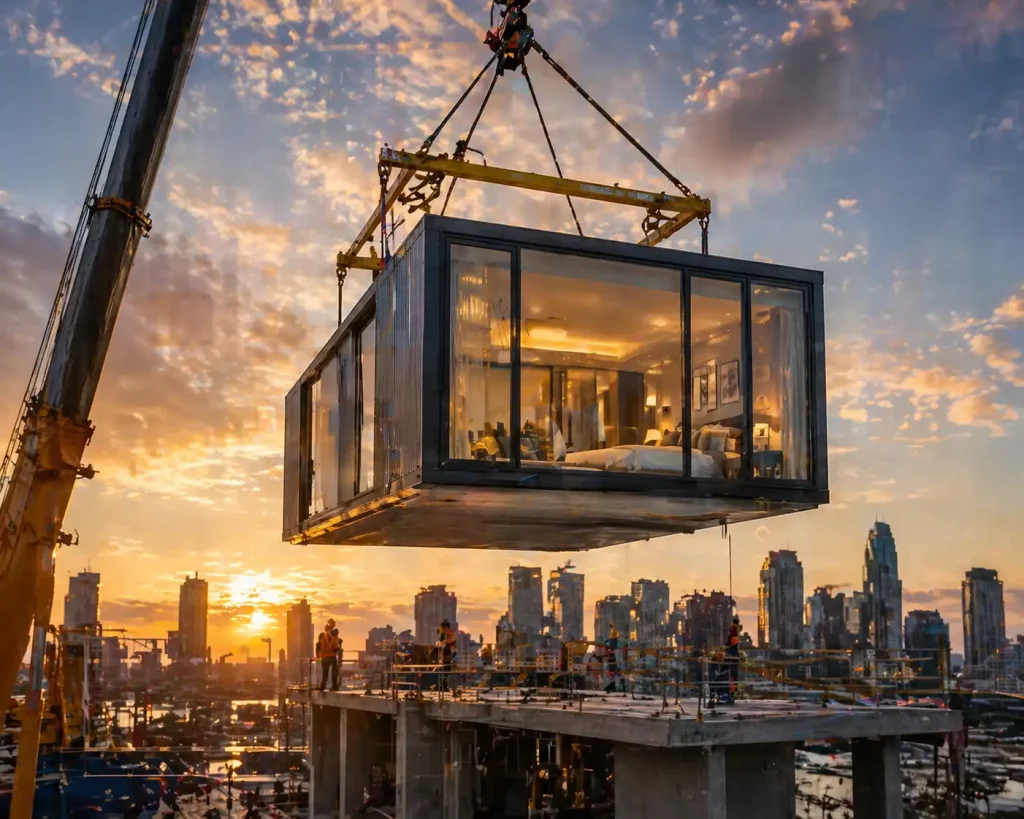
For decades, modular construction promised to reshape hospitality and rarely delivered at scale. That has changed. In 2026, modular guestroom pods have moved from experimental into mainstream, with major brands actively specifying modular delivery for select-service and limited-service properties. Project data from completed builds shows timeline reductions of roughly forty percent against conventional construction, which translates directly into earlier revenue, lower carrying costs, and competitive advantage in markets where time-to-open determines deal economics. The reasons are practical rather than theoretical, and the developers who understand where modular works and where it does not are positioning themselves to capture meaningful margin in their next development cycle.
What Modular Guestroom Pods Actually Are
The term modular covers several different construction approaches, and the cost and timeline outcomes vary based on which approach is used. Volumetric modular, the most common form for hospitality, delivers entire guest rooms as finished three-dimensional boxes built in a factory and transported to the site. Each pod typically arrives complete with framing, drywall, plumbing, electrical, HVAC connections, finishes, fixtures, and FF&E already installed. The pods are stacked and connected on site, with corridor connections, mechanical tie-ins, and exterior cladding completing the building.
Component modular takes a different approach, delivering panelized walls, prefabricated bathroom pods, or kitchen modules that arrive partially complete and are assembled on site within a conventional structural shell. Hybrid approaches combine modular pods within site-built structural systems, capturing some of the speed advantages while maintaining design flexibility for public spaces and amenity areas. Most hospitality projects in 2026 use either pure volumetric modular for limited-service brands or hybrid approaches for select-service properties, with full-service luxury hotels still typically using conventional construction for their custom programming.
How Modular Cuts 40% Off Construction Timelines
The timeline savings come from five specific operational advantages that compound across the project schedule. Understanding each of them explains why the percentage reduction holds up consistently across projects in different markets.
Parallel Manufacturing and Site Work
Conventional construction is sequential. Foundation work happens, then framing, then mechanical rough-in, then drywall, then finishes. Each trade waits for the previous one to complete. Modular construction breaks this dependency. While site work and foundation construction proceed on the building site, factories simultaneously build pods that will eventually arrive complete. The two workstreams compress what would have been an eighteen-month sequential schedule into roughly eleven months of parallel activity.
Weather Independence in Manufacturing
Factory-built rooms are not delayed by rain, snow, freezing temperatures, or extreme heat. Conventional construction in Northeast markets typically loses fifteen to thirty days per year to weather-related delays. Modular construction reduces weather contingency by sixty to eighty percent because the only weather-sensitive activities are foundation work, exterior cladding, and pod installation. Projects that would have lost a full month to a hard winter often lose only a few days when the structural work is completed before cold weather arrives.
Reduced Trade Stacking and Coordination
On a conventional construction site, plumbers wait for framers, electricians wait for plumbers, drywall installers wait for both, and finish trades wait for everyone. The trade stacking creates schedule risk at every handoff. In a factory environment, all trades work at parallel stations along an assembly process, with each pod moving through the stations in sequence. The coordination problem that consumes weeks of project schedule on conventional sites is reduced to factory floor logistics that operate on hours rather than days. The wider patterns of offsite construction versus traditional construction for hotels demonstrate why this single advantage often produces more time savings than any other modular benefit.
Quality Control Acceleration
Factory environments produce fewer defects than field construction because the conditions are controlled, the workers are repeating the same tasks, and quality inspection is built into the production line rather than performed at the end. The result is a meaningfully shorter punch list at project end. Conventional projects often spend four to eight weeks completing punch list items after substantial completion. Modular projects often complete punch lists in one to three weeks because most issues were caught at the factory rather than discovered in the field.
Faster Inspection Cycles
Pre-inspection at the factory means most code compliance work is reviewed before pods leave the production facility. On-site inspections then focus on connections, integration with site-built systems, and overall building completion rather than the comprehensive review required for fully field-built construction. Inspection scheduling delays, which often add weeks to conventional projects, are largely avoided because the on-site inspection scope is narrower and more predictable.
The Cost Story Is More Complex Than Just Cheaper
The honest answer about modular cost is that direct construction cost is typically five to ten percent higher than conventional construction, not lower as the marketing materials sometimes suggest. The cost advantage shows up only when the full project economics are calculated, which most early-stage budget conversations skip.
Soft cost savings from faster delivery often exceed the direct cost premium. Earlier opening means earlier revenue, with five additional months of operating revenue worth one and a half million to four million dollars on a typical 120-key select-service hotel depending on market. Carrying cost reduction during construction is meaningful, with construction loan interest, property taxes, insurance, and security all accruing during the build period. Reduced general conditions and supervision costs from the shorter on-site duration save roughly fifteen to twenty thousand dollars per month for typical project sizes. When the full math is run, total project economics typically favor modular for projects that fit the right profile, even with the higher direct construction cost. The framework for reducing construction costs during inflation applies particularly well to modular evaluation because the carrying cost savings compound when interest rates and material prices are both moving against project budgets.
Where Modular Works Best
The right project profile for modular hotel construction has several specific characteristics. Select-service and limited-service brands, including Hampton Inn, Holiday Inn Express, Fairfield Inn, and Comfort Inn, fit the modular profile well because their guest rooms follow consistent layouts that benefit from factory replication. Properties with eighty or more keys provide enough pod replication to capture factory efficiency, with smaller properties losing the volume benefits that make the economics work. Tight urban sites with limited staging benefit from modular because pods arrive complete and stack quickly, reducing the construction footprint impact on adjacent properties.
Cold-climate regions with short construction seasons capture outsized advantages from modular because the weather-related schedule risk is eliminated. Markets like Buffalo, Hartford, Boston, and Albany consistently see better modular outcomes than warm-climate markets where weather is rarely the binding constraint. Branded properties with consistent room standards across portfolios make modular more attractive because the design work amortizes across multiple projects, and the same factory-built pod design can serve multiple properties in a portfolio.
Where Modular Doesn’t Work
Honest evaluation matters because modular fails in certain project profiles, and the failures are expensive. Full-service hotels with custom food and beverage programs, ballroom configurations, and bespoke amenity spaces rarely fit modular construction because the public spaces require conventional construction anyway, which limits the savings to guest rooms only. Highly customized luxury properties that emphasize unique architectural features lose the modular advantage because every customization requires factory tooling changes that erode the cost benefits.
Sites without crane access or with overhead utility constraints cannot accommodate the equipment required to lift and place modular pods, ruling out modular regardless of other factors. Markets without nearby modular factories face transport costs that eat into the savings, with each hundred miles of transport adding roughly three to five percent to module costs. Renovation projects rarely benefit from modular because existing structures constrain pod insertion in ways that conventional renovation can manage. Some prefabricated bathroom and kitchen pods do appear in renovation projects, but full guestroom modular is impractical in existing buildings.
The Modular Manufacturing Process
Understanding what actually happens during modular construction helps developers plan the project sequence. Design coordination begins twelve to eighteen months before pod fabrication starts, with the factory engineering team partnering with the architect to translate design intent into manufacturable pod specifications. This phase is more involved than conventional construction because every detail must be resolved before factory production begins, with no field adjustments possible after fabrication.
Off-site assembly follows in dedicated stations along a production line. Framing happens at one station, plumbing and electrical at the next, drywall and insulation at the next, finishes at the next, and FF&E at the final station. Quality control inspection happens between each station, with issues caught and corrected before the pod moves forward. Transport logistics require oversized load permits, route planning, and police escorts in many jurisdictions. On-site stacking and connection happens once site preparation is complete, with cranes placing pods in sequence and connection crews tying mechanical and electrical systems together. Final integration completes the building with corridor finishes, exterior cladding, and public space construction. Approaching this with the structured framework outlined in the strategic roadmap for the commercial construction process produces predictable outcomes that conventional construction often cannot match.
Brand Compliance Status in 2026
Most major brands now accept modular construction for their select-service and limited-service portfolios, though acceptance varies by sub-brand and region. Marriott has approved modular for several of its mid-scale brands, with AC Hotels and select Residence Inn projects already delivered through modular methods. Hilton accepts modular for Hampton Inn, Home2 Suites, and Tru properties in most markets. IHG approves modular for Holiday Inn Express, Avid Hotels, and Staybridge Suites with regional variations. Choice Hotels and Best Western have approved modular construction for several of their brands, particularly in markets where local builders have established modular relationships.
PIP and brand approval workflows adjust slightly when modular is involved. The pre-construction design package review becomes more detailed because every pod specification must be locked before fabrication begins. Brand inspectors visit the factory in some cases, particularly for first-time modular projects with a given brand, to review construction quality during production. Once a factory has delivered approved pods for a particular brand, future projects move through approval more quickly. The broader trend that AI in hotel construction represents in the industry parallels the modular shift, with both reflecting the same operational thesis that controlled environments produce better hospitality construction outcomes than fully field-built work.
Quality Reality Versus Quality Myth
The perception that modular construction means lower quality persists in some corners of the industry, but the actual data points the opposite direction. Factory-built modules typically exceed site-built quality on framing accuracy, insulation installation, and mechanical, electrical, and plumbing rough-in because the conditions are controlled and the work is repeated thousands of times. Tolerance control runs tighter in factory environments, with framing accuracy measured in fractions of an inch versus site-built tolerances measured in inches.
Reduced exposure to weather during construction means fewer moisture-related defects in modular projects. Conventional construction in cold or wet seasons often traps moisture in walls and floors that surfaces years later as mold, finish failures, and structural issues. Factory-built pods avoid these problems because the entire construction occurs in climate-controlled facilities. The result is buildings that perform better over time, not just buildings that opened faster. The workforce challenges in hospitality construction that increasingly affect conventional construction quality also reinforce the modular case, with factory environments offering more stable employment and training that produce more consistent outcomes than the rotating subcontractor model that defines most field construction.
When Modular Pays Back the Premium
Running the actual math on a typical project clarifies when modular makes financial sense. Consider a 120-key select-service hotel in a Northeast market. Conventional construction takes roughly sixteen months from groundbreak to opening, with a total project cost of twenty-eight million dollars. Modular construction takes roughly ten months for the same building, with direct construction cost running approximately five percent higher at twenty-nine and a half million dollars.
On the surface, modular costs more. The economics shift when the six months of earlier opening is factored in. At average daily rates of one hundred sixty dollars and stabilized occupancy of seventy percent, the property generates roughly two and a half million dollars of revenue per six-month period. Construction loan interest savings on the shorter build period add another two hundred fifty to four hundred thousand dollars depending on financing structure. General conditions reductions add one hundred to one hundred fifty thousand dollars. The modular premium of one and a half million dollars is offset by total benefits of approximately three million dollars, which produces a net advantage of one and a half million dollars on a project that opened six months earlier than the conventional alternative. Capturing this advantage requires the kind of careful evaluation outlined in the hospitality construction trends shaping 2026, where modular sits alongside other shifts that change how owners approach development decisions.
Deciding Whether Modular Fits Your Next Project
Modular construction has moved past proof of concept. The brands have accepted it. The financing models have adjusted. The timeline savings are documented across enough completed projects that the question for hotel developers is no longer whether modular works. The question is whether your specific project profile, including site conditions, brand alignment, market characteristics, and capital structure, fits the modular advantage. Projects that fit the profile capture meaningful financial benefits. Projects that do not fit waste time and money pursuing what amounts to a square peg in a round hole.
Exploring whether modular construction fits your next hotel project? A pre-design conversation with a hospitality construction team that has worked across both modular and conventional delivery clarifies the cost picture, the timeline picture, and the brand approval picture for your specific site and program. Schedule a consultation through the contact page to walk through feasibility for your project.