
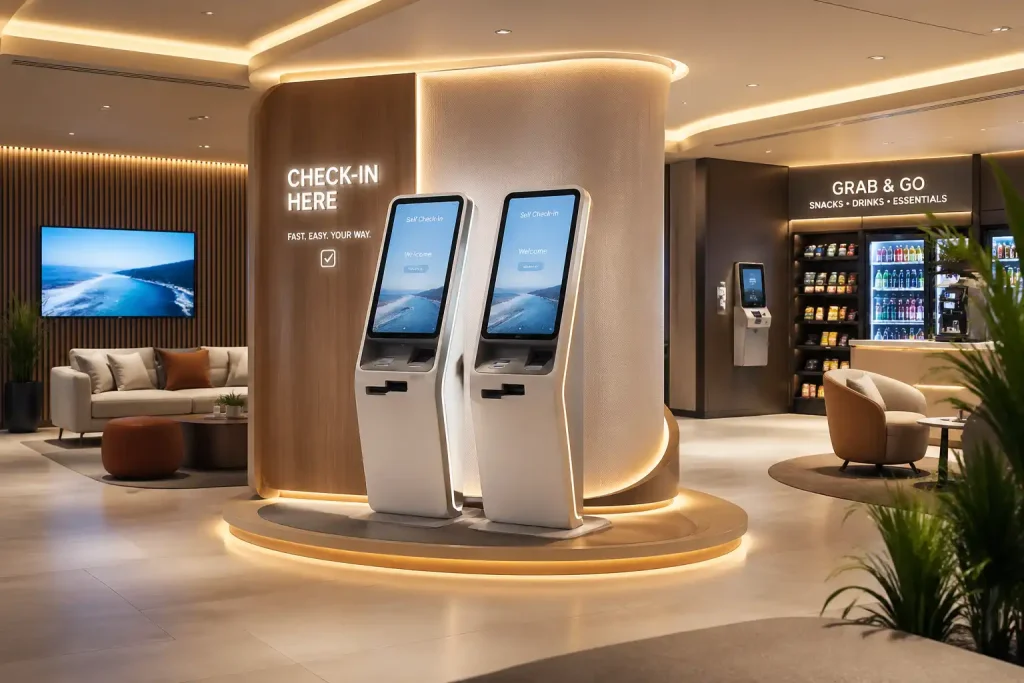
The labor math has changed. Economy and limited-service hotels that once staffed front desks twenty-four hours a day are quietly redesigning their lobbies to operate with reduced overnight coverage, partial coverage during off-peak hours, or in some cases no front desk staff at all between midnight and six in the morning. The economics are stark. A property running thirty-five percent labor-to-revenue cannot compete with one running twenty-two percent, and design-led automation is closing that gap faster than any other operational change in the segment. The question is no longer whether to integrate automation. It is how to design lobbies and check-in workflows that deliver the guest experience without carrying the labor burden that defined hospitality operations for the past fifty years.
Why Economy Hotels Are Leading the Automation Shift
Front desk staffing represents eighteen to twenty-five percent of operating expense at typical economy properties, with the variability driven by market wage rates and coverage hours. Wage inflation has accelerated since 2022, particularly in the overnight hours when shift differentials and limited candidate pools push hourly rates significantly above daytime equivalents. Recruiting and training overhead in tight labor markets adds further cost, with turnover at sixty to eighty percent annually at economy properties producing constant rehiring expense. The cumulative pressure on the labor line item has reached a point where ownership groups are reevaluating whether the traditional staffing model still produces acceptable returns.
Guest expectations have shifted in the same period, with younger travelers actively preferring digital-first interactions for routine transactions like check-in, key issuance, and account questions. The intersection of rising labor costs and shifting guest preferences creates an opening for automation-first design that did not exist a decade ago. The broader trend lines that luxury hotels are thriving while economy hotels are struggling capture make the case for operational restructuring at economy properties even sharper, with cost discipline becoming the differentiator between survival and decline at the value end of the segment.
What Human-less Doesn’t Mean
Important framing matters here. Automation-first design does not mean removing all human contact from the property. It means redesigning the operation so that humans handle the interactions where they add genuine value, while automation handles the routine transactions where human involvement adds cost without adding experience quality. The distinction shapes every subsequent design and operational decision.
Self-service handles routine transactions including check-in, room key issuance, account questions, and basic information requests. Human escalation, whether on-site or via video connection to a centralized support team, handles complex situations including booking modifications, guest service issues, and accommodation requests that automation cannot resolve. On-call or roving staff replace always-stationed front desk coverage during off-peak hours, with team members handling multiple roles instead of dedicated check-in coverage. Remote support via video kiosks bridges overnight hours when on-site staffing makes no economic sense, allowing guests to connect with trained agents serving multiple properties from a centralized location.
The Five Components of an Automation-First Lobby
Self-Service Check-In Kiosks
Free-standing or wall-mounted kiosks form the visible center of any automation-first lobby. Modern kiosks handle ID verification through credential scanning, payment processing through integrated card readers and contactless options, room key issuance through mobile credentials or physical key cards, upgrade upselling through guided prompts, and feedback capture through post-checkout surveys. Cost ranges run eight thousand to twenty-two thousand dollars per kiosk installed, with the variability driven by capability scope, branding requirements, and integration complexity with the property management system.
Mobile Check-In Infrastructure
Mobile check-in lets guests bypass the kiosk entirely, with arrival, identity verification, and digital key issuance happening through the brand mobile application before guests reach the property. The infrastructure required to support mobile check-in includes property Wi-Fi capacity that handles concurrent guest device connections, mobile-key compatible door locks that accept Bluetooth credentials, and integration between the mobile application and the property management system. Properties retrofitting older buildings face capital investment ranging from forty thousand to one hundred twenty thousand dollars depending on the existing infrastructure and the door lock retrofit scope.
Digital Wayfinding and Property Information
Touchscreen displays for amenities, breakfast service times, area attractions, and property information reduce front desk question volume by forty to sixty percent at properties that deploy them well. The displays handle the routine information requests that consume staff time without producing meaningful guest value, freeing whatever human staffing remains to handle higher-value interactions. Cost ranges run three thousand to nine thousand dollars per display installed depending on size, capability, and content management infrastructure.
Video Concierge Stations
On-demand video connection to a centralized support team allows remote staffing across multiple properties from a single hub. The model produces dramatic labor cost reduction at the property level because one centralized team can serve five to fifteen properties depending on call volume, replacing what would have been twenty-five to seventy-five front desk positions across those properties with five to ten centralized agents. Implementation cost runs fifteen thousand to thirty-five thousand dollars per property for the video kiosk hardware, with ongoing centralized service fees varying by provider and call volume.
Coffee, Snacks, and F&B Self-Service Zones
Self-service food and beverage zones designed for unattended operation extend the automation logic from check-in to amenity service. Modern coffee stations with multiple drink options, grab-and-go refrigerator displays with packaged food, retail snack vending alternatives, and self-checkout payment integration handle most overnight and off-peak food service without staffing. The capital investment runs twenty-five thousand to seventy-five thousand dollars depending on scope, with payback periods of fifteen to twenty-four months at most properties that previously staffed extended-hour breakfast or pantry service.
Lobby Design Choices That Support Automation
The physical lobby design determines whether automation feels welcoming or institutional. Sight lines matter because open lobbies allow guests to feel visually secure even without staff presence, while alcoves, hidden corners, or dim zones produce unease that drives negative reviews regardless of how well the kiosks function. Lighting that feels bright but warm signals attention even when no human is present, with smart lighting systems that brighten upon guest arrival adding a sense of attentiveness that fully automated environments otherwise lack.
Acoustics affect how the lobby feels when empty, with soft surfaces and sound dampening preventing the cavernous quality that turns automated lobbies cold. Security integration with cameras visible enough to reassure guests, paired with remote monitoring services, signals that the property is monitored without requiring on-site staffing. Signage and wayfinding need to be plentiful, multilingual where market demographics support it, and clear enough to remove most reasons guests would otherwise need to ask staff for directions. Comfortable self-service zones with seating near kiosks, phone charging surfaces, and small workspace areas remove the institutional feel that early automation deployments often produced. The principles outlined in how hotel design impacts guest experience and revenue apply with extra force in automation-first lobbies because the design choices have to compensate for the absence of constant human presence.
The Staffing Models That Work
Several operational models have proven viable for automation-first economy properties, each with different labor cost profiles and guest experience trade-offs. Reduced coverage staffs the front desk during peak check-in hours from three in the afternoon through eleven at night, with automation handling overnight and morning periods until staff returns for breakfast service. The model captures meaningful labor savings while keeping live staff available during the highest-traffic windows.
Roving staff replaces dedicated front desk coverage with one or two team members handling multiple roles, including housekeeping support, check-in escalation, breakfast oversight, and minor maintenance. The model works well at properties under one hundred fifty rooms where total task volume across roles fits within combined coverage. Centralized support has one support hub serving multiple properties via video and phone, dramatically reducing per-property labor while maintaining live human availability for guest issues. Fully self-service models work at brand-flexible properties or independent boutique operators willing to accept the trade-offs, with front desk presence limited to genuine emergencies. The structural pressures captured in the workforce challenges in hospitality construction reinforce why these models are spreading rapidly across the economy segment, with operators finding they can no longer staff traditional models even when they want to.
Cost Modeling: Labor Savings Versus Capital Investment
Running the actual numbers on a typical 100-room economy property clarifies the financial case. Traditional twenty-four-hour front desk staffing at the property level runs one hundred eighty thousand to two hundred forty thousand dollars annually, depending on local wage rates and coverage continuity. Reduced coverage staffing supplemented by automation runs ninety thousand to one hundred thirty thousand dollars annually for the same property, producing annual labor cost reduction of fifty thousand to one hundred fifty thousand dollars depending on the specific operating model.
Capital investment to enable the model includes one or two kiosks at fifteen thousand to forty thousand dollars total, mobile check-in infrastructure including door lock retrofits at forty thousand to one hundred twenty thousand dollars, video concierge integration at fifteen thousand to thirty-five thousand dollars, digital wayfinding displays at six thousand to eighteen thousand dollars, and lobby design modifications at fifteen thousand to forty thousand dollars. Total capital investment typically runs ninety thousand to two hundred fifty thousand dollars depending on scope and existing infrastructure. Payback periods of nine to twenty-two months produce the kind of capital efficiency that compares favorably with most other renovation investments. The relationship to broader renovation ROI patterns documented for 2026 places automation-first lobby renovation among the strongest returns available to economy property operators.
Guest Experience Outcomes
The counterintuitive insight from properties that have completed automation-first lobby renovations is that guest reviews often improve rather than decline after the operational shift. Several factors drive the improvement. Faster check-in eliminates the line that forms during peak arrival periods, particularly at properties with single-staff coverage during high-traffic windows. Twenty-four-hour service availability means guests arriving at three in the morning encounter a functional check-in process rather than a closed property or unresponsive staff. Privacy works in favor of guests who prefer minimal interaction, including business travelers ending long days and parents managing children after exhausting trips.
Service consistency improves because automation produces the same experience every time, while human staffing varies with individual skill, training, and energy across shifts. Younger guests actively prefer self-service for routine transactions, with millennial and Gen Z travelers consistently rating digital-first properties higher than equivalent staffed properties on review platforms. The combined effect produces review score patterns that surprise operators who feared backlash against automation but instead see the segment of guests who value efficiency rewarding the operational change.
Where Automation Falls Short
Honest evaluation matters because automation does not solve every operational challenge. Complex guest issues including booking modifications, payment disputes, accommodation requests, and compensation discussions still require human judgment that automation cannot deliver. Elderly guests and those uncomfortable with technology need accommodation that fully automated environments cannot provide, which is why most successful implementations maintain video concierge or on-call staff availability rather than eliminating human contact entirely. Cultural expectations vary by market, brand standards for franchised properties may mandate staff presence regardless of operator preference, and group bookings often require live coordination that exceeds what kiosks and mobile applications can deliver. The honest answer for most economy properties is that automation handles eighty to ninety percent of guest interactions while live staff capacity, whether on-site or remote, handles the remaining ten to twenty percent that produce the most operational complexity.
Brand Compliance and Automation
Most major brands now permit automation-first designs in economy and limited-service segments, with brand-approved kiosk vendors, PMS integration requirements, and mobile key infrastructure standards published in current franchise documentation. Properties that align with brand-approved vendor lists during planning experience smoother approval cycles than properties that select vendors independently and seek approval afterward. Brand inspection adjustments for automated properties have been documented across the major franchise families, with inspectors evaluating service standards through different metrics when on-site staffing is reduced or absent.
Independent and boutique properties have wider latitude for automation-first design because they answer only to their own operating standards. The pattern across both branded and independent properties is increasing acceptance and increasing investment, with operators recognizing that the operational changes are no longer experimental. The broader category of AI in hotel construction and how smart technology is changing operations includes lobby automation as one of the most mature and well-documented applications, with the patterns now well enough understood that planning errors come from execution rather than uncertainty about outcomes.
Renovation Path: How to Convert an Existing Lobby
Properties seldom convert to automation-first operations in a single renovation. The typical path runs through five sequenced phases that reduce risk and allow operational learning at each stage. Phase one adds kiosks alongside the existing front desk, allowing guests to choose self-service while maintaining traditional coverage. Phase two integrates mobile check-in and remote support, expanding the digital options without reducing staff presence. Phase three reduces or eliminates scheduled coverage hours, typically starting with overnight and gradually expanding the automated window. Phase four redesigns the physical lobby to support automation-first flow, with construction work typically combined with broader property renovation. Phase five optimizes the staffing model based on twelve to eighteen months of operational data, fine-tuning coverage hours and roving staff allocation.
Common missteps include buying technology before redesigning workflow, which produces kiosks that sit unused because the operational model still routes guests to staff. Underinvesting in change management for staff and guests creates resistance that undermines adoption. Choosing kiosks that do not integrate properly with the property management system creates dual-entry workflows slower than the original staffed process. Failing to maintain backup human support during early adoption produces guest experience failures that damage review scores during the most fragile phase of the transition. The patterns reflect what hospitality construction trends in 2026 reward operators who plan transitions carefully and punish those who pursue technology without operational redesign.
The Path Forward for Economy Property Operators
The economy hotel segment is restructuring around labor reality. Properties that adapt their lobby design and operational model to automation-first principles capture both cost savings and experience advantages. Properties that resist the shift will find themselves competing on price against operators with permanently lower cost structures, which is a losing position regardless of how well the resisting properties operate otherwise. The renovation question for economy hotel owners is no longer whether to integrate automation. The question is how quickly the property can be redesigned to support it without disrupting the operations that pay for the change.
Considering an automation-first lobby renovation for an economy property? A pre-design consultation can identify the workflow changes, kiosk integration paths, and physical redesign that fit your specific operational model and brand standards. Schedule a walkthrough through the contact page to discuss the labor cost reduction strategies that fit your property’s profile.