
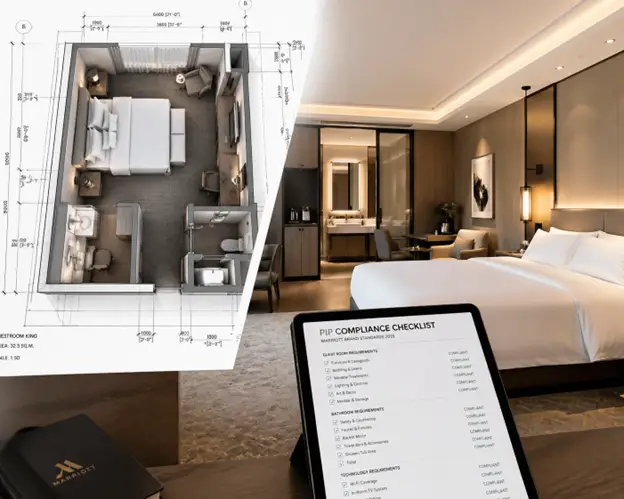
When a Property Improvement Plan notice arrives in your inbox, the timeline starts moving before most owners realize it. The relicensing window has already opened. The brand expectations have already been documented. And every week spent figuring out what the requirements actually mean is a week subtracted from the period you have to plan, finance, and execute the renovation. The 2026 Marriott brand standards bring meaningful updates across guest rooms, public spaces, technology integration, and sustainability compliance, which makes preparation more involved than in previous cycles. Owners who understand the full scope before scheduling their first contractor walkthrough save time, money, and the stress of last-minute design rework that derails inspection readiness.
What a Marriott PIP Actually Means for Your Property
A Property Improvement Plan is the mechanism Marriott uses to keep franchised hotels aligned with brand standards. The document specifies the renovation work required to maintain franchise compliance, and it carries deadlines that, if missed, can result in franchise termination. Most owners encounter their first PIP at one of four trigger moments. The first is relicensing, which typically happens every ten to fifteen years depending on the property and sub-brand. The second is ownership change, where the new owner inherits a fresh PIP scoped to the property’s current condition. The third is a scheduled brand audit, which occurs more frequently than owners expect at properties showing signs of deferred maintenance. The fourth is a voluntary upgrade request when an owner wants to reposition the property within the brand portfolio.
PIPs are issued by regional brand representatives in coordination with Marriott corporate, and the document distinguishes between mandatory items and recommended items. Mandatory items are non-negotiable for franchise compliance. Recommended items influence brand inspection scoring but allow more flexibility. Owners who treat both categories as equally urgent often overspend. Owners who dismiss recommended items as optional often underperform on inspection scores that affect future flexibility with the brand.
The 2026 Brand Standards That Just Changed
Marriott rolled out updated standards across the portfolio for 2026, and several categories saw meaningful revisions that affect renovation scope and cost. Guest room standards now emphasize updated soft goods palettes with neutral tones and natural texture, refreshed case good specifications with lighter wood finishes, and bathroom modernization that prioritizes vanity replacement over surface refinishing. Public space standards now include expanded technology integration requirements, particularly around mobile check-in support, digital wayfinding, and Wi-Fi coverage benchmarks. Lobby and food and beverage areas saw revised seating density and material durability standards that affect refresh decisions.
Sustainability standards represent the largest expansion in 2026. Properties undergoing PIP renovation are now expected to address energy efficiency through HVAC upgrades, LED lighting conversion, low-flow fixture installation, and in some markets, embodied carbon documentation. These overlays add scope that owners working from older PIP templates may not anticipate. Reviewing the hidden costs that most owners overlook before finalizing a budget can prevent the surprises that derail project economics in the second or third month of construction.
PIP Requirements Across the Marriott Sub-Brand Portfolio
The Marriott family includes more than thirty distinct brands, and PIP requirements vary meaningfully across them. Understanding what applies to your specific sub-brand changes how you scope, budget, and sequence the renovation.
Courtyard by Marriott
Courtyard properties operate on roughly seven-year refresh cycles for soft goods and twelve to fifteen-year cycles for full PIP renovation. The 2026 standards emphasize updated Lobby Bistro layouts, refreshed guest room palettes with the new Refresh design, modernized bathroom vanities, and expanded mobile check-in infrastructure. Courtyard inspectors prioritize the lobby experience, the Bistro F&B presentation, and guest room first impressions. Properties failing first inspection most commonly fail on Bistro presentation and outdated guest room case goods.
Residence Inn
Residence Inn PIPs are among the most capital-intensive in the Marriott portfolio because of in-suite kitchens, larger guest room footprints, and the gathering space requirements. The 2026 standards update kitchen module specifications with new countertop and cabinet finishes, refresh suite living area furniture, and modernize the lobby and gathering room with updated breakfast and evening reception standards. Outdoor amenity spaces, including sport courts, fire pits, and courtyards, fall under the PIP scope at properties where these features exist.
Fairfield Inn & Suites
Fairfield properties operate at the value tier of the Marriott portfolio, but the 2026 modernization standards have raised expectations notably. The new design package emphasizes refreshed guest rooms, updated breakfast bar layouts with modern food display, lobby transformation with technology integration, and exterior signage refreshes. Owners often underestimate the breakfast area scope, which has become a focal point of Fairfield brand inspection.
SpringHill Suites
SpringHill PIPs focus on the studio-style suite layout, with updated divider configurations, refreshed wet bar and minibar zones, and modernized work and lounge areas within the suite. Public space requirements include lobby and breakfast area refreshes aligned with the brand’s lifestyle positioning.
TownePlace Suites
TownePlace targets extended-stay travelers, and the 2026 PIP standards reflect that operational focus. In-suite kitchen updates, pet-friendly accommodation requirements, and outdoor gathering space renovations dominate the typical TownePlace PIP. Properties without compliant pet amenity zones often face expanded scope when these are added during PIP execution.
Marriott Hotels (Full-Service)
Full-service Marriott Hotels carry the most extensive PIP scope across the portfolio. Guest room renovation, ballroom and meeting space modernization, restaurant and bar refresh, lobby reimagining, club lounge updates, and concierge area redesigns all factor into the typical PIP. Capital allocation across these categories requires careful sequencing, especially when phasing work to maintain operational revenue. The phased renovation approach becomes essential at this scale, where shutting down the property entirely is rarely an option.
The Inspection Process Decoded
Brand inspections begin before the inspector arrives. Pre-inspection documentation requests cover renovation specifications, brand-approved vendor lists, and design package alignment. Inspectors arrive with the PIP document in hand and walk through specific touchpoints in a defined sequence. The exterior is evaluated first, including signage, landscaping, parking lot condition, and porte-cochere presentation. The lobby is next, with attention to flooring, seating, lighting, technology integration, and the front desk presentation. Guest rooms are sampled across multiple floor levels and configurations, with attention to bedding, case goods, bathroom condition, lighting, and general cleanliness as a proxy for ongoing maintenance discipline.
Public spaces and amenities follow, including F&B outlets, fitness centers, pool areas where applicable, meeting rooms, and corridors. Back of house areas are not typically inspected for guest experience, but mechanical rooms, kitchen back of house, and laundry areas are evaluated for code compliance and operational standards. Inspection scoring assigns weighted values across these categories, and properties that fall below threshold scores in any single category can fail overall, even when other categories score well. Owners preparing for inspection benefit from understanding which categories carry the highest scoring weight.
Realistic Cost Expectations for 2026 PIP Compliance
Marriott PIP costs vary by sub-brand, property condition, regional cost factors, and the renovation tier triggered by the PIP scope. The three-tier framework that applies across most Marriott properties provides a useful starting point.
A soft goods refresh PIP, which addresses bedding, drapery, paint, carpet, and minor case good touch-ups, typically runs ten thousand to seventeen thousand dollars per room across the limited and select-service Marriott brands. A case goods PIP, which adds furniture replacement, headboard and case good upgrades, lighting fixture replacement, and bathroom vanity updates, typically runs eighteen thousand to thirty thousand dollars per room. A full PIP renovation, which includes guest room gut renovation, bathroom replacement, full FF&E procurement, and public space modernization, typically runs thirty-five thousand to sixty thousand dollars per room for select-service properties and substantially higher for full-service Marriott Hotels.
Public space renovation budgets layer on top of per-room costs. A Courtyard Lobby Bistro renovation typically runs one hundred fifty thousand to three hundred thousand dollars depending on property size and existing conditions. A Residence Inn lobby and gathering area renovation typically runs two hundred thousand to four hundred fifty thousand dollars. Full-service Marriott Hotels often allocate one to four million dollars for public space renovation alone, depending on the scope of restaurant, ballroom, and lobby work. For broader cost context across renovation tiers, the complete budget guide for property owners provides reference ranges that align with Marriott PIP economics.
The 18-Month Timeline From PIP Notice to Final Inspection
PIP completion deadlines typically fall between twelve and twenty-four months from notice issuance, with eighteen months being the most common window. Working backward from the inspection date provides the only reliable framework for sequencing the project.
Months one and two are scope review and contractor sourcing. The PIP document gets reviewed line by line, condition assessments are completed, and three to five qualified hospitality contractors are interviewed. Selecting a contractor unfamiliar with Marriott specifications during this phase is the most common error owners make, and the consequences appear later as design rework and brand approval delays.
Months three and four cover design alignment and FF&E specification. The contractor and the design team coordinate against the PIP document to ensure every specified item is sourced from approved vendors with brand-compliant finishes. Procurement initiation begins here because lead times for case goods, custom millwork, and specialty FF&E often run sixteen to twenty-four weeks.
Months five and six handle permitting, brand approvals, and mobilization planning. Brand approval gates appear at multiple points in the design process, and missing them triggers rework that pushes the entire schedule. Permitting timelines vary by jurisdiction, but Northeast metro areas typically require four to ten weeks for hotel renovation permits depending on the scope.
Months seven through fourteen are the active construction phase, during which most owners face the operational challenge of maintaining revenue while crews work through the property. The strategies for renovating an occupied hotel without losing revenue determine whether the financial model holds together through this phase. Phasing work by floor, by wing, or by space type allows the property to continue selling rooms while construction progresses. Properties that attempt full shutdown during PIP renovation face revenue losses that often exceed the renovation premium for phased execution.
Months fifteen through seventeen address punch list completion and final brand approvals. Brand inspectors often perform pre-inspections during this window, identifying remaining issues before the formal inspection date. Month eighteen is the formal brand inspection, and properties that have followed the timeline arrive at this date with confidence rather than panic.
Where Owners Lose Money on Marriott PIPs
The most expensive mistakes on Marriott PIPs are not in the construction. They are in the planning and procurement stages. Specifying off-brand materials that fail brand approval and require rework is the largest budget killer, often adding fifteen to thirty percent to material line items. Hiring a generalist contractor unfamiliar with Marriott specifications is the second largest, because rework, brand approval delays, and inspection retakes compound the original cost. Underestimating procurement lead times forces owners into expedited shipping, contractor schedule overruns, and delayed openings that create ongoing carrying cost exposure.
Skipping the pre-construction brand alignment meeting is a less obvious but equally costly error. These meetings, which Marriott’s regional teams typically support, allow owners to confirm scope interpretation, identify potential variances, and align on approval pathways before construction begins. Owners who skip these meetings often discover scope misalignment in week six or week ten of construction, when the cost of correction has multiplied. The common renovation mistakes that cause cost overruns offer additional patterns worth reviewing before any major capital commitment.
How to Negotiate Your Marriott PIP Scope
PIPs have more flexibility than most owners assume. The document represents the brand’s preferred scope, but it accommodates legitimate property constraints and reasonable alternative paths. Documenting building constraints that justify scope adjustments is the foundation of any negotiation. Structural limitations, code conflicts, mechanical capacity issues, and historic preservation overlays all qualify as legitimate grounds for variance requests.
Proposing alternate solutions that meet brand intent without exact specification match is a more sophisticated approach. If a brand specifies a particular flooring product that conflicts with property conditions, presenting a substitute that matches durability, aesthetic, and warranty terms often wins approval. If a brand specifies a lighting layout that conflicts with electrical panel capacity, presenting a phased approach that meets the standard within an extended timeline often wins approval. The framework for negotiating your hotel PIP without losing your flag walks through the specific language and documentation that produces successful variance requests.
Phasing capital-intensive items across multiple budget cycles is another underused strategy. Some PIP items, particularly mechanical replacements and major public space renovations, can be approved for phased execution if the owner presents a credible multi-year capital plan. Working with regional brand representatives before final PIP issuance, when the document is still in draft, produces better outcomes than negotiating after the document is final.
Choosing the Right Renovation Partner for a Marriott PIP
The contractor selection decision affects every other variable in the PIP execution. A hospitality specialist with documented Marriott portfolio experience reduces brand approval cycles, prevents specification errors, and maintains schedule discipline through procurement and installation. A generalist commercial contractor without hospitality depth often costs more in rework, schedule slippage, and inspection retakes than the apparent savings on the original bid.
The right questions to ask before signing focus on Marriott portfolio history, brand approval relationships, FF&E procurement capabilities, and phased construction experience for occupied properties. Reviewing case studies of comparable Marriott projects the contractor has completed, including timelines, budget performance, and inspection outcomes, separates qualified candidates from those better suited for non-branded work. Comprehensive hotel renovation services require a partner who understands every layer of brand compliance, from initial scope review to final inspection sign-off.
Planning Your Marriott PIP Path Forward
Marriott PIPs reward owners who treat the renovation as an eighteen-month strategic project rather than a six-month construction sprint. The earliest planning decisions, including scope review, contractor selection, and procurement timing, shape every downstream outcome. Properties that begin work the moment the PIP notice arrives consistently complete inspection on schedule, on budget, and with brand inspector confidence intact.
If a Marriott PIP is on your horizon, the right time to plan is before the inspection window opens. Walking through your specific compliance requirements with a hospitality renovation team that has executed across the Marriott portfolio clarifies the scope, the budget, and the timeline before any capital is committed. Schedule a consultation through the contact page to discuss your property’s path to inspection readiness.