
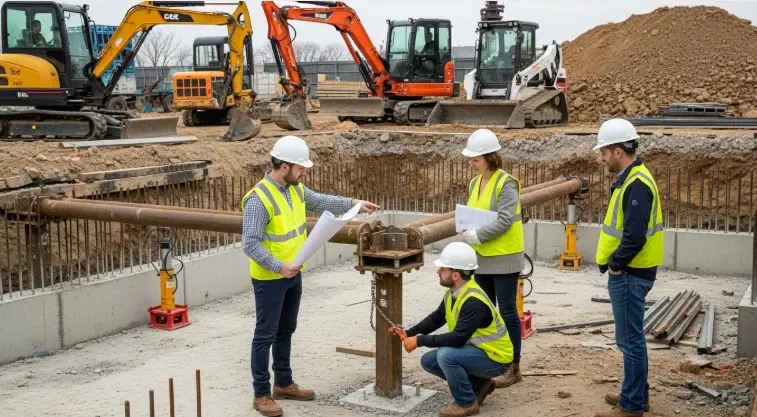
Why Underpinning matters in Hotel Construction
In hotel development, the foundation is not just a structural element, it is a financial safeguard. Every decision in early-stage hotel construction cost planning, hotel architecture planning, and site selection eventually depends on ground conditions and load behavior.
This is where underpinning becomes critical. Whether you are upgrading an existing property into a luxury hotel, adding a basement for parking, or stabilizing a structure on weak soil, underpinning ensures the building remains safe, stable, and investment-ready.
For developers and investors, understanding underpinning is not optional, it directly impacts risk, ROI, and long-term asset value in commercial construction for hotels.
Quick Answer: What is underpinning in construction? (For Hotel Developers & Investors)
Underpinning in construction is the process of strengthening or stabilizing the foundation of an existing structure by extending its depth or transferring its load to a more stable soil layer.
In hotel development, underpinning is used when:
- Existing buildings are renovated or expanded
- Nearby excavation threatens structural stability
- Soil conditions are weak or uneven
- High-rise hotel loads require foundation strengthening
It is a critical technique to ensure structural safety, prevent settlement, and support long-term hotel asset value.
What is underpinning in construction? Role Explained in Hotel Development Projects
What is underpinning in construction? Key Structural Concept in Hospitality Projects
Underpinning strengthens existing foundations by:
- Extending foundation depth
- Increasing load-bearing capacity
- Stabilizing soil beneath structures
In hotel construction, it is commonly used in:
- Renovation of heritage hotels
- Basement expansion for parking or BOH areas
- Structural upgrades for luxury repositioning projects
This makes it a key part of adaptive reuse and redevelopment strategies in hospitality construction process planning.
Why underpinning is critical in hotel construction & hospitality infrastructure
Hotels are high-occupancy, high-load environments. Even minor structural movement can impact safety, operations, and brand reputation.
Underpinning ensures:
- Structural safety during expansion or renovation
- Protection of adjacent properties in dense urban sites
- Compliance with building codes and safety regulations
- Long-term durability of hotel foundations
Without proper underpinning, risks include settlement, cracking, façade distortion, and in extreme cases, structural failure, any of which can shut down revenue-generating operations.
Scope of underpinning in hotel construction projects
Underpinning is not a single task, it supports multiple phases of hotel development:
- Basement excavation for parking or service areas
- Foundation strengthening for vertical expansion
- Stabilizing structures in soft or variable soil conditions
- Supporting adjacent building construction in urban hotels
- Retrofitting older hotels for modern compliance standards
In large-scale hospitality projects, underpinning often becomes a hidden but critical part of the hotel development timeline.
Key factors hotel owners must understand about underpinning
Cost impact of underpinning in hotel construction
Underpinning can significantly influence hotel construction cost due to:
- Soil condition variability
- Depth and complexity of reinforcement
- Specialized engineering and labor requirements
While expensive upfront, it often prevents far greater long-term structural repair costs.
Influence on hotel development timeline
Underpinning can affect project scheduling in several ways:
- Requires geotechnical investigation before execution
- May extend pre-construction planning phases
- Unexpected soil conditions can delay critical path activities
Proper planning and sequencing reduce disruption to the overall hotel development timeline.
Design & architectural flexibility
Underpinning enables architectural possibilities that would otherwise be impossible:
- Basement-level spas, restaurants, and parking
- Structural upgrades in adaptive reuse hotels
- Luxury expansions in constrained urban plots
It gives architects more freedom in hotel building design without compromising safety.
Sustainability & structural resilience
Modern hotel developments increasingly focus on long-term sustainability. Underpinning contributes by:
- Extending building lifecycle
- Reducing demolition and reconstruction needs
- Supporting green retrofitting strategies
This aligns with LEED-oriented hospitality construction goals.
How Underpinning is Used in Hotel Construction Projects
Step 1: Site investigation & soil testing
- Geotechnical surveys assess soil strength and composition
- Weak zones and settlement risks are identified
Step 2: Structural assessment
- Existing load conditions are analyzed
- Stress points and foundation risks are mapped
Step 3: Underpinning method selection
- Mass concrete
- Beam and base system
- Mini-piled underpinning
Step 4: Excavation & strengthening
- Controlled excavation beneath foundation
- Sequential reinforcement to maintain stability
Step 5: Structural integration & finishing
- Load transfer completion
- Backfilling and waterproofing
- Final structural validation
Comparison: Underpinning Methods in Hotel Construction
| Method | Strength | Cost | Speed | Best Use in Hotels |
|---|---|---|---|---|
| Mass Concrete | Medium | Low | Slow | Small renovations |
| Beam & Base | High | Medium | Medium | Urban hotel upgrades |
| Mini Piled | Very High | High | Fast | High-rise hotel projects |
| Resin Injection | Medium | Medium | Fast | Minor settlement repair |
Cost breakdown: underpinning in hotel construction budgets
Direct cost factors
- Geotechnical investigation and surveys
- Engineering design and consultancy
- Materials (concrete, steel, piles)
- Heavy excavation equipment
Indirect cost impacts
- Construction delays during reinforcement
- Design modifications during execution
- Monitoring systems for safety assurance
Cost variation by hotel type
- Budget hotels → minimal or no underpinning
- Luxury hotels → moderate to extensive reinforcement
- Heritage hotels → high cost due to preservation constraints
Real-world example: underpinning in hotel redevelopment
A 30-year-old urban hotel converting into a luxury boutique property required basement expansion for a spa and wellness center. Soil analysis revealed weak subsoil layers.
Solution:
- Mini-piled underpinning system installed
- Foundation deepened by 6–10 meters
- Construction executed in phases to keep structure stable
Outcome:
- Added revenue-generating spa facility
- Increased property valuation by over 20%
- No structural settlement post-completion
This is a typical example of underpinning directly enhancing ROI in hotel redevelopment.
Common mistakes hotel developers make with underpinning
- Skipping detailed geotechnical surveys
- Underestimating soil variability across site zones
- Starting excavation without structural sequencing
- Choosing incorrect underpinning method for load conditions
- Poor coordination between architect and structural engineer
These mistakes often lead to budget overruns and structural risks.
ROI & investment insights: why underpinning matters
Protects asset value
Prevents structural damage that can significantly reduce hotel valuation.
Enables expansion and revenue growth
Allows additional floors, basements, or functional upgrades.
Reduces long-term maintenance costs
Stable foundations minimize future cracking and repair cycles.
Hotel construction considerations influenced by underpinning
Site selection & soil conditions
Weak soil increases both cost and complexity of foundation systems.
Design strategy (luxury vs budget hotels)
Luxury hotels often require deeper structural modification and stronger foundations.
Construction methods (modular vs traditional)
Modular hotel construction reduces foundation stress, lowering underpinning needs.
Sustainability & green building practices
Extending structural life reduces material waste and environmental impact.
Operational efficiency post-construction
Stable foundations improve long-term operational reliability and reduce maintenance downtime.
FAQs about underpinning in construction
What is underpinning in construction and why is it important for hotels?
It stabilizes foundations, ensuring safety and durability in hotel buildings.
How much does underpinning cost in hotel construction?
Costs vary widely based on soil, depth, and method—often a major early-stage expense.
Can underpinning be done without evacuating a hotel?
Yes, in many cases work is phased to allow partial or full operation.
Is underpinning permanent or temporary?
It is a permanent structural solution when properly designed and executed.
What are the risks of improper underpinning?
Settlement, cracking, structural instability, and potential building failure.
How long does underpinning last?
When correctly installed, it lasts the lifetime of the structure.
Is underpinning required for basement construction in hotels?
Often yes, especially in urban or weak soil conditions.
Which underpinning method is best for high-rise hotels?
Mini-piled underpinning is typically preferred due to high load capacity.